
By Candis Smith, Certified Life and Executive Coach and Founder of Shaping Pathways Inc · Last updated November 2026
A quick note before we begin: coaching is not therapy. I am not a licensed psychologist or healthcare professional, and what you read here is meant to educate, not to replace professional care. I also can’t promise you a particular outcome. What happens for you depends on the work you put in and the season you’re in. Wondering what you would actually get out of coaching? Here are the real benefits of transformative life coaching, what each one looks like in everyday life, and what the research does and does not tell us
Transformative life coaching works on the beliefs and fears sitting underneath your choices, which is why its benefits reach further than one finished goal. People commonly report clearer direction, steadier confidence, healthier boundaries, better relationships, calmer decisions, more resilience through change, and a firmer sense of identity and purpose. The benefit I care about most is that the change lasts, because it rests on who you are and not only on what you produce.
If this is your first article in the series, I’d start with what transformational life coaching is. You’ll also hear this work called transformative life coaching or transformation coaching. Same work, different labels. Here I want to answer the question most people are quietly asking: what will I actually get?
The Lie Behind “The Benefit of Coaching Is Bigger Results”
Most coaching gets sold on outcomes. The promotion. The raise. The calendar that finally runs like clockwork. Those things can come, and I’m genuinely glad when they do.
But there’s a lie folded into that pitch. It suggests the point of coaching is to get more out of you, faster. Many of the people who reach out to me are not short on output. They’re running hard, and they’re doing it well. What they’re short on is peace, and the sense that the person carrying all of it is still them.
I know that place because I lived there. So when I talk about the benefits of transformative life coaching, I’m not talking about wringing another ten percent out of an already full life. I’m talking about what becomes possible when you no longer have to earn your place every single day.
What Is Transformative Life Coaching?

Transformative life coaching starts with the person before it starts with the plan. Rather than setting a goal and mapping steps toward it, we look first at the beliefs, fears, and old stories that have been quietly making decisions on your behalf. Once those are named and replaced with something true, the goals you choose come from steadier ground.
If you’re comparing this to other kinds of coaching, I wrote about how transformational and executive coaching differ, and I walk through the process step by step so you know exactly what you’d be saying yes to.
9 Benefits of Transformative Life Coaching
These are the shifts I see most often in the people I coach. Not everyone experiences all nine, and they rarely arrive in this order. But they come up again and again, across industries and across seasons of life.
1. Clarity about what you actually want
Many capable people have spent so long meeting expectations that they’ve never stopped to ask what they want. Coaching gives you protected time to ask that question honestly, and to sort out which desires are truly yours and which ones you picked up from your family, your industry, or your fears. That sorting alone can lift a surprising amount of weight.
2. Confidence that does not depend on your last win
If your confidence rises and falls with every result, you’re living on a scoreboard. I did that for years, and it wears you down in a way a good night’s sleep doesn’t fix. Transformative coaching works on the belief underneath, so your worth stops being renegotiated every time a project goes well or goes sideways.
3. Freedom from the performance trap
If you overwork to feel safe, you already know how draining that is. Coaching helps you see the pattern clearly, trace where it began, and loosen its hold one honest conversation at a time. I’ve written more about this in Over Performing at Work and When Success Feels Like a Trap.
4. Healthier boundaries and real rest
Rest stops feeling like a reward you have to qualify for. You start saying no without a long explanation, and yes without quiet resentment. If you suspect you’ve been running on fumes, The Lie of the Empty Tank is an honest place to check in with yourself.
5. Decisions that come from clarity, not fear
Fear makes more of our decisions than we like to admit. Once you can name the fear, you can choose around it. Reviews, salary conversations, and major career moves feel very different when they’re no longer a verdict on your worth. Performance Review Anxiety goes deeper into this.
6. Stronger, more honest relationships
The way you treat yourself spills into the way you treat everyone else. As you stop performing, you can be more honest with your team, your spouse, your children, and your friends. With four children at home, from a five-year-old to a nineteen-year-old, I’ve learned that the people closest to us can always tell the difference between a parent who is present and one who is performing. Honest relationships tend to feel safer, not riskier.
7. A steadier sense of identity
This is the deepest benefit, and the hardest one to put into words. You become less reliant on your title, your output, or anyone’s approval to know who you are. If that question has been following you around, read Who Are You Without the Title?
8. Resilience through change
Change will keep coming: reorganizations, transitions, loss, new chapters at home. A grounded identity doesn’t make any of it easy, but it keeps you from disappearing inside it. Anyone who has paddled a kayak through choppy water knows the waves don’t stop because you’re steady. You simply stop being thrown by every one of them. I explore this further in Leading Through Unexpected Change.
9. Alignment between your faith, your purpose, and your work
For many of my clients, the biggest relief is that they no longer have to split themselves in two. Their faith stops being something they check at the office door and starts shaping how they lead, decide, and live.
What the Research Says About the Benefits of Coaching
I want to be straightforward with you here. There is solid, widely cited research on coaching in general, and far less rigorous research on transformational coaching specifically.
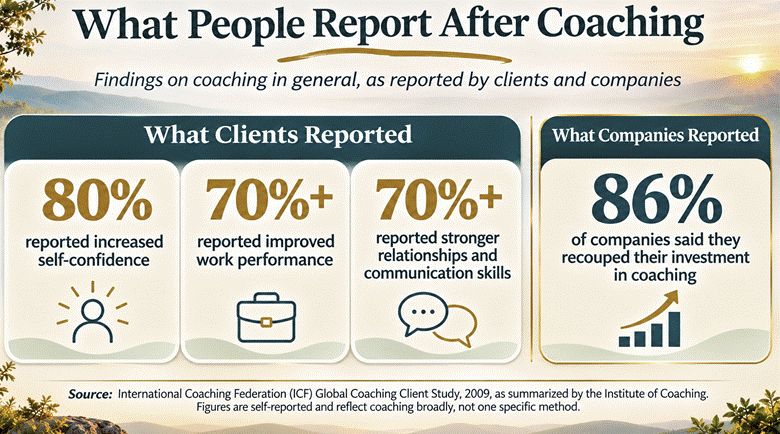
According to the 2009 ICF Global Coaching Client Study, as summarized by the Institute of Coaching, about 80 percent of coached clients reported improved self-confidence, around 70 percent reported better work performance, and roughly 70 percent or more reported stronger relationships and communication skills. The same body of ICF data reports that 86 percent of companies said they recouped their investment in coaching.
Two honest cautions. These numbers are self-reported, and they describe coaching broadly, not one particular method. So I hold them as encouraging rather than as a promise. What I can tell you is that they line up with what I see in my own practice.
How Long Before You Notice the Benefits?
Most people feel some relief early, often within the first month, simply from finally naming what has been going on. The deeper changes, like a steadier identity or a new relationship with rest, usually build over several months of consistent work. I map out that rhythm month by month in How Life Transformation Coaching Works. Every person’s timeline is different, and I will never promise you a specific outcome by a specific date.
Who Benefits Most From Transformative Life Coaching?
- Accomplished professionals who feel empty, worn down, or like they’re playing a part
- Leaders who keep running into the same emotional pattern in different roles
- People in transition: a new role, a career change, or a season of loss
- Anyone who wants growth that includes their faith, not just their productivity
- Women of color in leadership carrying visibility, bias, and identity pressure all at once
What Transformative Life Coaching Will Not Do
I would rather you trust me than be impressed by me, so here is the other side.
- It will not replace therapy. If you’re dealing with trauma, depression, or another mental health condition, please see a licensed professional first. Coaching can sit alongside that care.
- It will not do the work for you. I walk beside you, but the steps are yours to take.
- It will not fix your workplace. It can change how you carry yourself there, and what you decide to do about it.
- It will not guarantee a result. Anyone who promises one is selling something.
Why I Believe in This Work: My Own Story
I didn’t learn any of this from a textbook. For more than 25 years I built a career as an executive, and by most outside measures it was going well. And still, there was a void I couldn’t fill with one more accomplishment. My personal life carried hard seasons of its own, which I share more openly on my about page.
What turned things around for me became the foundation of Shaping Pathways Inc: Renew, Restore, Release. I renewed my mind, body, and spirit. I restored my sense of worth by reclaiming my voice. And I released the beliefs that had been quietly running my life. Every benefit on this list is something I lived first, long before I ever coached anyone through it.
What My Clients Say
In their own words, as shared on my site:
“This coaching experience transformed my career and personal growth. I met my inner self and recognized the God-gifted potential within me.” Julia
“Working with Candis transformed my leadership journey, helping me find my voice, align goals with purpose, and step into my dream role confidently.” Miltena, working woman
“This is such a safe and empowering space where growth feels natural, this is the best investment I have made in my personal growth.” Abena, writer
How the PATHs™ Framework Creates These Benefits
Every client I work with moves through the same framework, PATHs™. It’s how the benefits above move from something you read about to something you live.
P — Permission to Pause & Be Present. Step out of high-functioning autopilot and make room to hear what is really going on.
A — Awaken Your Identity. Reconnect with who you are beyond roles, expectations, or performance.
T — Transform What’s Been Tied to You. Release the internal narratives, pressures, and past patterns that no longer serve your calling.
H — Heal Through Insight & Revelation. Bring to the surface what has been buried, and release it with grace, not guilt.
S — Step Boldly Into Your Alignment. Move forward with clarity, peace, and leadership rooted in your God-given identity.
A 5 Minute Exercise: Which Benefit Do You Need Most?
Before you decide anything about coaching, give yourself five quiet minutes with this. A notebook and a cup of coffee are all you need.
- Read the 9 benefits above and circle the 2 that made you pause.
- Next to each one, write down the last time you felt its opposite. For example, the last time you felt you had to prove yourself.
- Ask yourself what you were afraid would happen in that moment.
- Write 1 sentence about what you would want to be true instead.
That sentence is a meaningful place to begin a Discovery Call. My free guide walks through a longer version of this kind of reflection.
Mistakes That Limit the Benefits
Expecting change without the inner work. The practical tools help, but the lasting change comes from the belief underneath them.
Quitting when it gets uncomfortable. The friction that often shows up in months 2 and 3 is frequently where the real shift begins.
Measuring yourself against someone else’s timeline. Your pattern took years to form. Give yourself grace while it unwinds.
Treating coaching as a replacement for community. Your faith, your friends, and when needed, a licensed professional all belong in your circle of support.
The Identity Factor Behind Every Benefit
If you remember one thing from this article, let it be this. Every benefit above flows from one shift: moving your sense of worth off your performance and onto something steady underneath it.
When your identity is settled, you can pursue big things without needing them to rescue you. I have seen it in my own life and in the lives of the people I coach: consistent small steps, grounded in faith, integrity, and perseverance, lead to profound transformation. That is the real return on transformative life coaching.
Ready to Experience These Benefits for Yourself?
If something here sounded like the life you’ve been hoping for, you don’t need to have it all sorted out before you reach out. A Discovery Call is simply a conversation about what’s going on and whether working together makes sense. No pressure, and no pretending.
You can see current packages and pricing here, explore my coaching services, or visit the Shaping Pathways homepage to see how I work with leaders and professionals. When you’re ready, schedule a Discovery Call and we’ll begin right where you are.
Frequently Asked Questions
What is transformative life coaching?
Transformative life coaching is an approach that works on the beliefs, fears, and identity underneath your goals. Its aim is change that lasts, because it addresses what drives your choices and not only the outcome you’re hoping for.
What are the benefits of transformative life coaching?
Commonly reported benefits include clearer direction, steadier confidence, freedom from overworking, healthier boundaries, calmer decision making, stronger relationships, more resilience through change, and a firmer sense of identity and purpose.
Is transformative life coaching worth it?
That depends on what you need and how willing you are to do the inner work. Broad coaching research reports high satisfaction along with improved confidence and performance, though much of it is self-reported. A Discovery Call is a low-risk way to find out whether it fits you.
How long does it take to see results from coaching?
Many people feel relief within the first month from naming what’s going on. Deeper shifts in identity and confidence usually build over several months of consistent work. Timelines vary, and no honest coach can guarantee a date.
What is the difference between transformative coaching and regular life coaching?
Regular life coaching usually begins with a goal and builds a plan. Transformative coaching begins with the person pursuing the goal, working on identity and belief first so the change holds up under pressure.
Is transformation coaching the same as therapy?
No. Therapy often focuses on diagnosing and treating mental health conditions and processing the past with a licensed clinician. Coaching looks forward and works with people who are generally healthy. If you’re dealing with trauma or a mental health condition, please see a licensed professional first.
Can transformative life coaching help with burnout?
It can help you understand the patterns behind burnout, like overperforming and tying your worth to your output, and help you build healthier boundaries and rest. It is not a medical treatment. If burnout is affecting your health, please also talk with a doctor or licensed professional.
Can faith be part of transformative life coaching?
Yes. In my practice, faith is welcome and often central. You set the depth and the pace, and if you’d rather begin with the practical side, that’s exactly where we’ll start.
Do I have to live near you to work with you?
No. I coach clients nationwide and internationally by phone or video.
About the Author: Candis Smith
Candis Smith is a certified life and executive coach and the founder of Shaping Pathways Inc., an identity and leadership coaching practice. An executive with over 25 years of experience, she coaches professionals and leaders across industries, nationwide and internationally, helping them understand their true identity and how it shapes the way they approach everything in their lives. Blending Christian principles with practical strategies, her mission is to help you shape a pathway that honors your gifts, your calling, and the leader you were created to be.
Connect with Candis on LinkedIn, YouTube, or Instagram, or read her full story on the about page.
Related reading: What Is Transformational Life Coaching? · How Life Transformation Coaching Works · Transformational Coaching vs Executive Coaching · Who Are You Without the Title? · The Pressure to Hold It All Together
Explore coaching services: Homepage · Executive Coaching · Leadership Coaching · Career Development Coaching · Personal Development Coaching · FAQs · Free Guide