
Running on empty halfway through the year? A leader’s honest burnout check for spotting stress and resetting your priorities with no extra pressure.
If you are a leader running on empty, the honest truth is this: burnout is not a sign that you are failing. It is a sign that your tank has been giving more than it has been getting. A real leadership burnout check helps you spot the early signs of stress, name what is draining you, and reset your priorities before exhaustion hardens into something worse.
Now take a breath. You made it halfway through the year. That matters. But if you are being honest, you are tired in a way that sleep does not fix. You smile in the meeting. You hit the number. You answer the late email. And still, something inside you feels flat.
I want to sit with you in that feeling for a moment. Not to fix you. Just to tell you the truth about the empty tank, and the lie it keeps whispering.
The Lie You Have Been Believing
Here is the lie. The lie says that if you just push a little harder, do a little more, and prove yourself one more time, then you will finally feel like enough. So you push. You perform. You carry the team, the results, and the pressure like it is your job to hold it all together. For a while, it works. The promotion comes. The praise comes. The next role opens up.
But the tank keeps dropping.
The lie of the empty tank is that you can keep pouring out from a place that is not being filled. You cannot. No leader can. Not the CEO, not the founder, not the person everyone calls strong. Scripture puts it plainly. “Come to me, all you who are weary and burdened, and I will give you rest” (Matthew 11:28). That verse was not written for weak people. It was written for tired ones. There is a difference.
So before we go one step further, let me ask you a gentle question. When was the last time you checked your own tank, not your calendar, but your actual energy? If you cannot remember, keep reading. This is your burnout check.
What Burnout Really Is, and Why It Reaches Your Soul
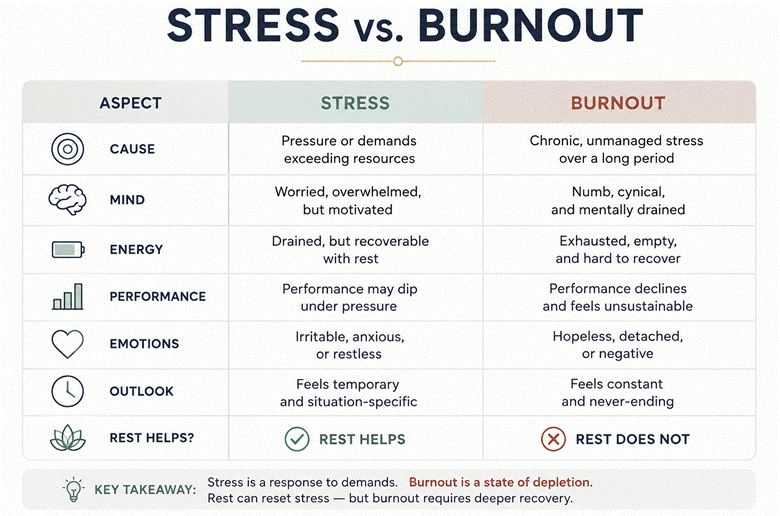
Let me make this simple. Stress and burnout are not the same thing.
Stress is what happens when there is too much on your plate right now. A big deadline. A hard quarter. A tough conversation. The good news about stress is that it usually eases when you rest. You take the weekend, you catch up on sleep, and you feel more like yourself again.
Burnout is different. Burnout lingers even after time off. You take the vacation and come back just as empty. You sleep eight hours and still feel drained. That is the warning sign. When rest stops working, you are not just stressed. You are running on fumes.
This matters for leaders in a deep way, because burnout does not only touch your schedule. It reaches your soul. When you are burned out, you start to lose the things that made you good in the first place. Your patience. Your creativity. Your care for people. Your sense of who you are.
The numbers back this up. Recent research found that 56% of leaders reached burnout in a single year, up from the year before, and nearly three out of four senior leaders say they work without enough rest. You are not imagining it, and you are not alone in it. The exhaustion you feel is real, and it is common at the top.
But common does not mean okay and here is the part that hurts to say. The world will keep taking from a tank and you never say is empty. So the check has to start with you.
The Silent Signs of Leadership Stress
Most leaders do not miss burnout because they are careless. They miss it because they are good at hiding it. You have trained yourself to look fine. So let us name the quiet signals that something is off, before they grow loud.
Watch for these 5 early signs of leadership stress:
- You are pulling back. You speak less in meetings. You used to lean in, and now you sit back. Withdrawal is often the first crack.
- You feel cynical. The mission that once moved you now sounds like noise. You catch yourself rolling your eyes at things you used to believe in.
- Your sharpness is slipping. Small errors creep in. Details get missed. You reread the same email three times and still cannot hold it.
- Your patience is thin. You are short with people you love and people you lead. The empathy that made you a good leader feels far away.
- Your body is talking. The tight shoulders. The bad sleep. The skipped meals. Research shows nearly half of stressed executives skip meals because of work. Your body keeps the score even when your mind refuses to.
Did any of those land? If even 2 of them felt like a mirror, do not panic. Awareness is not the problem. Awareness is the beginning of the way back. And that way has a name.
The PATHs™ Perspective: Leading Yourself Through the Empty Season
I coach leaders through a faith-based framework I call PATHs™. It stands for Pause, Awaken, Transform, Heal, and Step. It is how I help high-performing professionals reconnect with who they are underneath the title. When the tank is empty, this is the road home.
1. Pause
You cannot check a tank while the engine is running. Pause is the holy act of stopping long enough to feel the truth. Not a full sabbatical. Just a real breath. Even God rested on the seventh day, and He was not tired. If rest was built into the design of the One who made you, then rest is not laziness. It is wisdom. Pause is where the burnout check actually begins.
2. Awaken
Once you stop, you start to see. Awaken is where you get honest about what is really draining you. Is it the workload, or is it the need to be seen as the strong one? Is it the job, or is it the fear of what happens if you slow down? Awakening is uncomfortable. It is also where freedom starts. You cannot heal what you will not name.
3. Transform
This is where the reset happens. Transform is when you take what you learned in the awakening and let it change how you lead. Maybe you say no to the meeting that adds nothing. Maybe you hand off the task you were only holding out of pride. Transformation is not about doing more. It is about carrying less of what was never yours to hold.
4. Heal
Healing is the part most leaders skip. We patch the leak and rush back to the road. But healing asks you to actually refill, not just stop leaking. This is prayer. This is time with people who know your real name. This is remembering that your worth was never tied to your output. “He restores my soul” (Psalm 23:3). Not your resume. Your soul.
5. Step
Then, and only then, you step forward again. Step is movement without the frenzy. It is leading from a full tank instead of a dry one. You still work hard. You still lead well. But now you are pressing forward from peace, not from panic.
That is the PATHs™ way through burnout. Not more pressure. A different posture.
A Step-by-Step Burnout Check
Let me make this practical. Set aside 30 quiet minutes this week. That is it. Here is how to run your own honest check.
- Rate your tank. On a scale of 1 to 10, how full is your energy today? Do not overthink it. Write the first number that comes to mind. This is your starting truth.
- Name the 3 biggest drains. What are the 3 things pulling the most energy from you right now? Be specific. Not “work,” but “the 7 a.m. calls” or “proving myself to the new boss.”
- Name the 3 biggest fills. What actually gives you energy back? Time with your kids. A quiet morning. A walk near the water. Notice how often the fills get cut first when you are busy.
- Ask the honest question. Is my exhaustion easing with rest, or staying no matter what? This one answer tells you whether you are stressed or burning out.
- Reset one priority. Do not reset everything. Choose 1 thing to release, delegate, or reschedule this month. One. Resetting your priorities is not a giant overhaul. It is one honest choice repeated over time.
- Bring it to prayer. End by handing the list to God. “Cast all your anxiety on him because he cares for you” (1 Peter 5:7). You were never meant to carry the tank alone.
If you want to go deeper on this, I wrote a companion guide walking through the midyear burnout check step by step. But even doing just these 6 things this week will move you.
Mistakes to Avoid on the Way Back
As you do this work, watch for the traps. These are the ones I see high-performing leaders fall into again and again.
The perfection trap. You try to do the reset perfectly. You build the whole new system, the whole new morning routine, the whole new life. Then you miss a day and quit. Do not chase perfect. Chase honest. Small steps grounded in faith beat a flawless plan you abandon.
The masking trap. You keep performing “fine” for everyone around you. Masking is exhausting, and it is lonely. You do not have to fall apart in the boardroom. But find at least 1 safe person who gets the real you. Isolation feeds burnout. Honesty starves it.
The over-performing trap. You believe that if you just achieve the next thing, the tired feeling will lift. It will not. Burnout is not cured by another win. It is cured by remembering you were already enough before the win.
The guilt trap. You feel guilty for resting, guilty for saying no, guilty for needing anything at all. But guilt is not from God. Rest is not something you have to earn. It is something you were designed to receive.
One thoughtful writer put it well in a piece on finding the way out of burnout: recovery is rarely about a single dramatic change and more about slowly rebuilding a life that fits who you actually are. That is exactly right. You do not blow it all up. You come home to yourself, one choice at a time.
Real Life: What This Looks Like at the Top
Let me paint a picture you might recognize.
A senior leader I will call Marcus ran a large team. From the outside, he was thriving. Big title. Strong results. The person everyone called when things got hard. Inside, his tank had been on empty for months. He was sleeping badly. He snapped at his kids. He sat in his car in the driveway some nights because he could not carry the weight through the front door.
Marcus did not need another strategy. He needed to stop believing the lie of the empty tank.
When he finally ran his own honest check, he saw the truth. His biggest drain was not the workload. It was the fear that slowing down would prove he was not as strong as everyone thought. His identity had quietly attached itself to being the one who never ran out.
So he made one small reset. He gave up the 1 standing meeting that drained him most and used that hour to breathe, pray, and think. That was it. Not a resignation. Not a dramatic exit. One honest change.
Within a few weeks, his patience came back. Then his creativity. Then, slowly, himself. He did not become a lesser leader. He became a truer one.
That is what this work does. It does not make you smaller. It gives you back the parts of you that burnout was quietly stealing.
The Identity Factor: Leading From Who You Are, Not From Fear
Here is the deepest layer, and the reason the tank kept dropping in the first place.
Most leadership burnout is not really an energy problem. It is an identity problem.
When you lead from fear, you are always performing. You chase the next role because you are afraid of who you are without it. You answer every email because you are scared of looking replaceable. You never say your tank is empty because empty feels like exposed. That fear is a bottomless tank. No promotion will ever fill it, because the hole was never in your calendar. It was in how you saw yourself.
But when you lead from identity, something changes.
You already know who you are. You are not your title. You are not your last performance review. You are a person of worth before you produce a single thing. When you lead from that place, work stops being the thing that proves you and becomes the thing you get to do from a settled heart.
This is the shift I care about most as a coach. Fear-led leaders burn out because they are trying to earn what they already have. Identity-led leaders last, because they are working from fullness, not for it.
The empty tank lie only works when your identity is up for grabs. The moment you remember whose you are, the lie loses its grip. You can rest without guilt. You can say no without panic. You can lead the second half of the year from peace, not pressure.
That is the reset. Not a harder push. A truer foundation.
Frequently Asked Questions
What is a burnout check?
A burnout check is a short, honest review of your energy, stress, and priorities at the halfway point of the year. You rate your energy, name your biggest drains and fills, and reset 1 priority. It helps you catch the signs of leadership stress before they turn into full burnout.
How do I know if I am stressed or actually burned out?
Ask 1 question. Does rest help? Stress usually eases after a weekend or a good night’s sleep. Burnout lingers even after time off. If you rest and still feel empty, you are likely dealing with burnout, not just stress.
What are the early signs of leadership burnout?
The common early signs are pulling back in meetings, growing cynical about the mission, making small mistakes, losing patience with people, and physical symptoms like poor sleep or skipped meals. If 2 or more sound familiar, it is time for a check.
How do I prevent burnout without slowing down my career?
You prevent burnout by resetting priorities, not by working less at everything. Release 1 draining task, protect the things that refill you, and lead from identity instead of fear. Leading from fullness makes you more effective, not less.
Can faith really help with leadership burnout?
Yes. Faith reminds you that your worth is not tied to your output. Rest becomes something you receive instead of something you earn. For many leaders, that shift in identity is the very thing that breaks the cycle of over-performing.
What is the PATHs™ framework?
PATHs™ stands for Pause, Awaken, Transform, Heal, and Step. It is a faith-based framework I use to help leaders reconnect with their identity beyond their title and lead from a full tank instead of an empty one.
How often should I do a burnout check?
A quick check once a month keeps you honest, with a deeper one at midyear and year-end. It only takes about 30 minutes, and it can save you months of running on empty.
One Last Word
You made it this far in the year. That took something out of you, and it is okay to admit that.
The empty tank lie will keep telling you to push harder but you do not need to prove one more thing. You need to remember one thing. You are already enough, and you were never meant to run on empty.
Run your check this week. Reset 1 priority. Refill your soul. Then lead the second half of the year from a full tank, with clarity, honesty, and faith.
If you are ready to do this work with support, that is exactly what I am here for. But that is a conversation for later. For today, just start with the truth. Your tank matters, because you matter.