
The system was never designed to sustain the pace it demands from you. And nobody is going to tell you that while they still need you to perform. If you are a high-performing professional who feels exhausted, invisible, or like the next promotion still will not be enough, this article is for you.
You got the title. You got the salary. You got the respect, at least on paper. But somewhere between the Monday morning calls and the Friday night emails that nobody told you would never stop, something shifted. You started running on empty. And the scariest part? You kept running anyway.
That is what performance burnout feels like. It does not always look like falling apart. Sometimes it looks like the most put-together person in the room.
I have been there. After 25 years in the industry and in executive leadership, I know what it feels like to pour everything into your career and still feel like it is not enough. I know the weight of proving yourself in rooms where people underestimate you. And I know what it costs, not just professionally, but spiritually and personally.
The good news? You can break the cycle. But first, you have to understand what is actually happening inside it.
What Is Performance Burnout, Really?
Most people think burnout just means being tired. But for leaders and high performers in mid-level to executive roles, burnout runs much deeper than physical exhaustion.
Performance burnout is what happens when your entire sense of worth is tied to how well you perform at work. It is the relentless pressure to prove yourself, to stay relevant, to justify your seat at the table. It is showing up every day not from a place of purpose, but from a place of fear.
According to recent insights from Forbes, burnout is not just about work. It is about how we live, the pace we accept as normal, the boundaries we refuse to set, and the identity we have built entirely around our output.
You can read more about that perspective here: Why Burnout Isn’t Just About Work, It’s About How We Live.
For many leaders in corporate, the weight goes even deeper than the workload. You may be navigating systems that were not designed with you in mind. You may be managing the unspoken pressure of being “the first,” the “only,” or the one everyone is watching. That kind of invisible labor adds up fast, regardless of your title, your background, or how long you have been at the table.
Let me say this plainly: you are not broken. The system is broken. And you deserve a way out of the cycle it has trapped you in.
Why the Corporate Ladder Is a Trap for High Performers
Here is something nobody tells you when you start chasing promotions: the ladder does not end. The moment you land the role you have been working toward, there is already a new target in front of you. And if your peace of mind depends on reaching the next level, you will never actually arrive.
This is one of the biggest traps high performers fall into. We chase career advancement, leadership recognition, and executive-level titles because we believe they will finally make us feel enough. Enough seen. Enough valued. Enough secure.
But that feeling? It never comes from the outside. Not from a title. Not from a salary. Not from a corner office.
One of the verses that has anchored me through some of my hardest seasons is Proverbs 4:23: “Above all else, guard your heart, for everything you do flows from it.” Whether faith is part of your story or not, the principle holds. Your heart, your core identity, is the engine of your leadership. When that engine is running on anxiety and the need to prove yourself, everything you build is built on an unstable foundation.
The trap is not the job. The trap is leading from a place of fear instead of a place of identity.
The PATHs™ Framework: A Way Back to Yourself
At Shaping Pathways Inc., I use a faith-based coaching framework called PATHs™. It stands for Pause, Awaken, Transform, Heal, and Step. Each element is designed to walk a high-performing leader out of burnout and back into wholeness.

P – Pause
The first step out of the burnout cycle is the hardest one for most leaders: you have to stop. Not forever. Just long enough to hear yourself think. Performance anxiety tells you that slowing down means falling behind. I have had to come back to this truth many times in my own journey: “Be still, and know.” Psalm 46:10 has been my personal reminder that stillness is not a setback. It is where clarity lives. And whether or not you share my faith, I think most of us know deep down that we were not built to run at this pace forever.
A – Awaken
Once you pause, you can start asking better questions. Not “How do I get the next promotion?” but “Who am I outside of this title?” Awakening is the process of recognizing how your identity has gotten tangled up in your performance. It is the moment you start separating what you do from who you are.
T – Transform
Transformation does not happen all at once. It happens in small, consistent choices. There is a verse I return to often, Romans 12:2, that says, “Do not conform to the pattern of this world, but be transformed by the renewing of your mind.” For me, that is a spiritual truth. But even outside of faith, the science of neuroplasticity tells us the same thing: your mind can be rewired. This is where you start reshaping the beliefs that have kept you on the burnout treadmill. Beliefs like: I must work hard because everyone is depending on me. If I say no, they will think I am not a team player. I have to keep proving myself or I will lose my job. And if I am not consistently seen as a high performer, everything I have built could disappear.
H – Heal
Healing in leadership looks like setting boundaries that you actually keep. It looks like asking for help without shame. It looks like grieving the years you spent performing instead of living. And yes, it can look like therapy, spiritual direction, or honest conversations with people you trust.
S – Step
Finally, you step back into your leadership, but differently now. From a place of clarity, not crisis. From purpose, not pressure. You step into a career that aligns with your values, not just your ambition.
5 Practical Steps to Break the Burnout Cycle
Here is where we get specific. These are not quick fixes. They are real shifts that require intention. But they work.
1. Do a Reality Audit
Sit down with a journal and ask yourself: What am I actually doing vs. what I said I would prioritize? Where is my energy going, and is it aligned with my values? When did I last feel genuinely at peace at work? Be honest. This is not about judging yourself. It is about seeing clearly.
2. Name the Fear Underneath the Performance
Most overperformance is driven by fear. Fear of being seen as incompetent. Fear of losing the job. Fear of letting people down. Fear of being exposed as not enough. Until you name the fear, it drives you. So write it down. Say it out loud. Bring it into the light, whether that looks like prayer, journaling, or an honest conversation with someone you trust.
3. Establish Non-Negotiable Boundaries
Not soft guidelines. Real ones. No email after 7pm. Full weekends with your family every other week. A lunch break that is actually a break. Yes, the work will still be there. And no, nothing will fall apart because you took care of yourself. In fact, your leadership will get sharper.
4. Redefine What Success Looks Like for You
Corporate culture will always define success as the next level up. But what does success look like in your life, on your terms? What does a thriving day feel like in your body? What kind of leader do you want to be remembered as? Start building your career around that answer, not around someone else’s ladder.
If you want to go deeper on the intersection of identity, income, and burnout, especially in high-pressure industries, this resource is a great place to start: Identity, Income, and Burnout: What No One Tells High Performers in Financial Services.
5. Build a Support System That Tells You the Truth
You need people around you who are not just rooting for your career, but for your whole life. A mentor. A coach. A trusted community. I love how Proverbs 11:14 puts it: “Where there is no guidance, a people falls, but in an abundance of counselors there is safety.” That resonates deeply with my own faith journey. But even if you approach it differently, the truth underneath it is universal. You were not designed to carry this alone. Nobody is.

3 Mistakes That Keep You Stuck in the Cycle
Even with the best intentions, leaders often fall back into burnout because of these 3 patterns:
Mistake 1: Masking
Masking means showing up with a polished exterior while you are falling apart on the inside. It is the brave face in the board meeting when you are running on 4 hours of sleep. It is saying “I’m great!” when someone asks how you are doing. Masking keeps you safe in the short term. But long-term, it disconnects you from yourself and from the people you lead.
Mistake 2: Perfectionism
Perfectionism is fear wearing a productive costume. It tells you that if everything is flawless, you will finally be safe. But perfection is a moving target, and chasing it will keep you on the hamster wheel indefinitely. Good enough, done with integrity, is almost always better than perfect and late or perfect and exhausted.
Mistake 3: Tying Your Worth to Your Wins
Your value as a human being is not contingent on your last quarter’s results. But if you have been in corporate long enough, that lie starts to feel true. When your identity lives in your achievements, every setback feels like a personal failure. Every loss of momentum feels like you are losing yourself. Breaking this pattern is the heart of the work we do at Shaping Pathways Inc.
What This Looks Like in Real Executive Life
Imagine this: A VP of Operations at a Fortune 500 company. She has been with the company for 11 years. She is respected, recognized, and quietly falling apart. She has not taken a full vacation in 3 years. Her family asks why she seems distracted, even when she is present. But she does not connect any of it to burnout. She just thinks she needs to push a little harder, sleep a little better, get through this next quarter. That is the thing about burnout in high performers. Most of them do not recognize it until the body, the relationship, or the breaking point forces them to stop.
This is not a rare story. I hear versions of it every week.
What this leader needs is not a better time management system. She needs to reconnect with who she is outside of her job title. She needs space to ask: Do I actually want the next level? Or have I just been conditioned to believe I should want it?
When she starts leading from identity instead of performance, something shifts. Her decisions become clearer. Her presence becomes more powerful. Her relationships at work and at home actually improve. That is what reclaiming your identity does for your leadership.
The Identity Factor: Everything Changes When You Lead From Here
Here is the shift that changes everything: What if you stopped leading from fear and started leading from identity?
Identity-based leadership means you know who you are before you walk into any room. You know your values, your boundaries, and your worth. You do not need a promotion to feel secure. You do not need external validation to know you belong. You show up from a place of overflow, not desperation.
For me personally, Ephesians 2:10 is the verse that grounds this truth: that you are God’s handiwork, created to do good works that were prepared in advance for you. That is the foundation my coaching is built on. But wherever you are on your faith journey, here is what I want you to hear: your career is part of your purpose. But your purpose is not your career.
When you know the difference, burnout loses its grip on you. Because you are no longer running on a treadmill trying to earn your worth. You already know your worth. And from that foundation, you can build something that actually lasts.
That is the kind of leadership I help people build at Shaping Pathways Inc. Not just a better career strategy. A better foundation.
Frequently Asked Questions About Burnout and Leadership
What are the signs of burnout in high-performing executives?
Common signs include chronic exhaustion, emotional detachment from work you once loved, difficulty making decisions, feeling like nothing you do is ever enough, loss of personal boundaries, and physical symptoms like sleep problems or headaches. For leaders, burnout often hides behind productivity, which makes it harder to recognize.
Can you recover from burnout while staying in your current job?
Yes, but it requires real changes, not just a weekend off. Recovery while staying in your role means establishing firm boundaries, redefining your relationship with performance, building a support system, and doing the internal work of reconnecting with your identity. Sometimes it also means having honest conversations with your manager about workload or role expectations.
How does faith help with burnout recovery?
Faith offers something that corporate culture cannot: an identity that is not performance-based. When you ground your sense of worth in who God says you are rather than what your company thinks of you, the anxiety of proving yourself begins to ease. Prayer, scripture, and spiritual community provide rest for the soul that productivity cannot touch.
Why do high achievers experience burnout more often?
High achievers are often wired to push through pain and discomfort. They have been rewarded for overperforming their entire lives, so stopping feels dangerous. They also tend to tie their identity closely to their results, which means any sign of slowdown feels like failure. This creates a cycle where burnout is both more likely and harder to admit.
What is the difference between stress and burnout?
Stress usually has an identifiable cause and resolves when the stressor goes away. Burnout is deeper and longer-lasting. It often involves emotional numbness, a loss of motivation that rest alone does not fix, and a disconnection from the meaning behind your work. Burnout is what happens when stress becomes your permanent baseline.
How long does it take to recover from burnout?
Recovery timelines vary. For some, significant shifts happen within weeks when they make intentional changes. For others, full recovery takes months or longer. The most important factor is not the timeline but the depth of the work. Surface-level fixes produce surface-level results. Real recovery requires addressing the root beliefs and patterns that led to burnout in the first place.
What role does identity play in preventing burnout?
Everything. When your identity is rooted in who you are rather than what you produce, you are far less vulnerable to the burnout cycle. You can take a loss without losing yourself. You can say no without feeling like you are losing your place. Identity-based leadership is the most sustainable form of leadership there is.
You Were Made for More Than This Treadmill
You did not work this hard and come this far to spend the rest of your career running on empty. The world needs your leadership. But it needs the real you, not the exhausted, performing, mask-wearing version that corporate culture has rewarded.
You deserve to lead with clarity, with purpose, and with peace. That is not a luxury. That is what you were created for.
If you are ready to stop surviving your career and start living it, I would love to walk with you through that process. At Shaping Pathways Inc., we help high-performing professionals in mid-level to executive roles reconnect with their identity, reclaim their peace, and build careers that align with who they truly are.
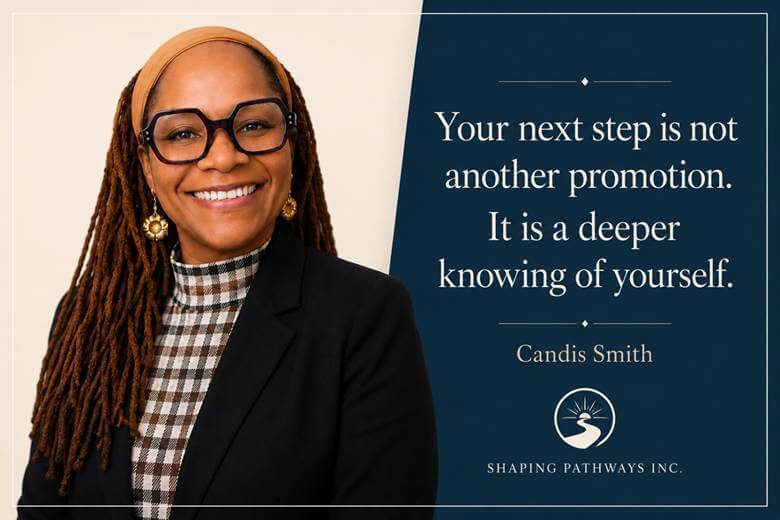
Your next step is not another promotion. It is a deeper knowing of yourself. And it starts with one conversation. Book your discovery call today.