
Your performance review is one person’s opinion about one season of your work. It is not the final word on your worth, your future, or who you are. When you read it while burned out, stressed, and anxious, it can feel like a verdict. But it is feedback. It is not a verdict, and you are allowed to know the difference.
If your stomach tightens when the review invite hits your calendar, you are not alone. You are tired. There is a real difference, and that difference matters more than you have been told.
The Fear You Carry Into the Room
Most high performers do not say this part out loud. So let me say it for you.
You are afraid that the review will confirm a quiet thought you already carry. The thought that you are not doing enough or your impact is not being seen or expectations not met. The thought that one day someone will notice you are not as capable as they believed. You have built a whole career, and still a single comment from a manager can keep you up at night.
That fear has a name in many circles. People call it performance review anxiety. Some call it high-functioning anxiety, because you look calm on the outside while your mind races on the inside. Whatever you call it, it is common among leaders in mid-level and executive roles. You are not the only one carrying it. You are just one of the few willing to be honest about it.
Here is the part that gets missed. The fear is rarely about the review itself. It is about what you have made the review mean.
What a Review Actually Is
Let me make this plain.
A performance review is a snapshot. It is taken by one person, or a few people, from one angle, over a limited window of time. It is shaped by their memory, their mood, their priorities, and the things they happened to see. It does not capture the early mornings no one watched. It does not capture the meeting you saved, the teammate you mentored, or the calm you held when everything was on fire.
A review measures output. It does not measure your soul. It cannot. No form has a box for who you really are.
So when a review feels like a final ruling on your value, something deeper is happening. The review did not become bigger. Your capacity to hold it got smaller. And the thing that diminshes that capacity, more than anything else, is burnout.
The Real Link Between Burnout and Performance Reviews
This is the heart of it, so stay with me.
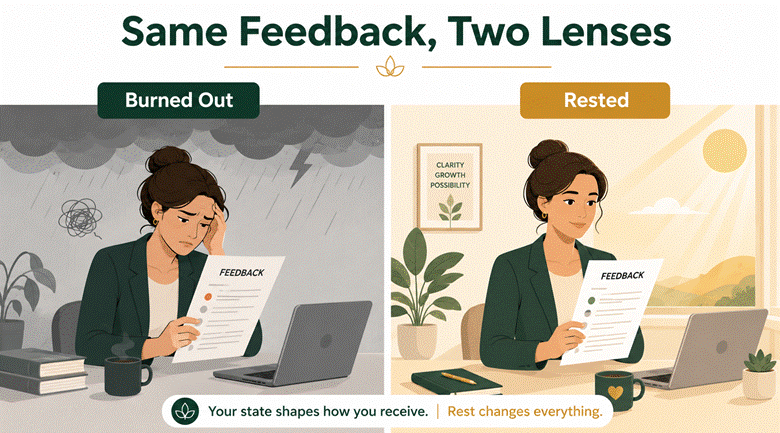
When you are rested and grounded, feedback lands as information. You hear a critique, you weigh it, you keep what is useful, and you let the rest go. You can disagree without falling apart.
When you are burned out, the same words land like a hammer. You cannot tell the difference between “this project missed the mark” and “you are a failure.” Your nervous system has been running on alert for so long that every piece of feedback feels like a threat.
The American Psychological Association describes workplace burnout as a syndrome that comes from long-term workplace stress that has not been managed well. It tends to show up in three ways. First, deep emotional exhaustion. Second, a growing distance or cynicism toward your work. Third, a shrinking sense that what you do is effective. The APA also notes that burnout can quietly impair memory and attention, the very tools you need to think clearly. So when you sit down to read a review in that state, your mind is already working against you.
So the connection between burnout and performance reviews is simple and important. Burnout does not just drain your energy. It distorts your judgment about yourself. It takes a normal piece of feedback and turns it into evidence against your whole identity.
Why You Cannot Show Your Best From Empty
There is a second cost here, and high achievers feel it deeply.
When you prepare for a review from a place of stress, you do not present the best version of your work. You play small. You over-explain. You apologize for things that need no apology. Or you do the opposite. You armor up, you get defensive, and you miss the chance to be seen clearly.
The same is true if you are the one writing reviews for your team. A review written from exhaustion is rarely fair or generous. Tired leaders write tired feedback. They notice the gaps and miss the growth. They reward the loud and overlook the steady.
In both cases, burnout robs the moment of truth. You cannot represent your value well, and you cannot see the value of others well, when you are running on empty. This is why protecting your inner steadiness is not a soft idea. It is strategy.
The PATHs™ Perspective
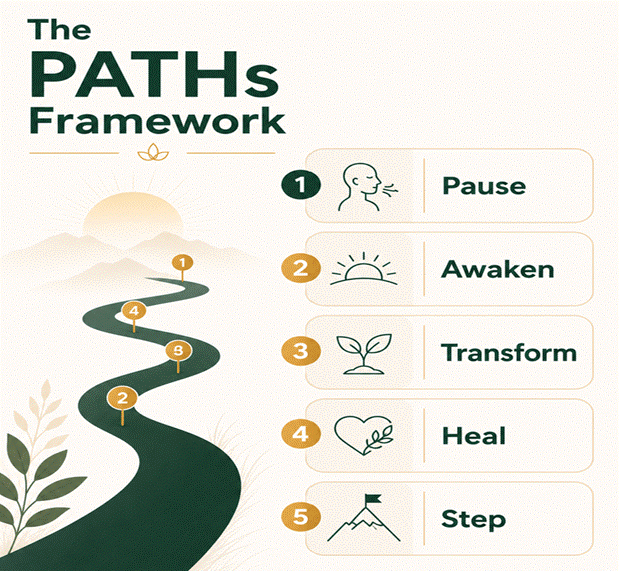
At Shaping Pathways, I walk leaders through a faith-based framework called PATHs. It is built for exactly this kind of moment, when the outside world is trying to tell you who you are. Here is how it speaks to review season.
1. Pause
Before you react to a review, stop. Do not reply from the first wave of feeling. Breathe. Put space between the feedback and your response. The pause is where your power lives. In that quiet, you remember that you get to decide what the words mean, not the other way around.
2. Awaken
Wake up to what is really going on inside you. Ask honestly, “Is this fear about the feedback, or about an old story I keep believing?” Many leaders are still trying to outrun a voice from years ago that said they were not enough. Awakening means seeing that voice for what it is. It is old. It is not the truth.
3. Transform
Now change the meaning. Take the review and sort it. Keep what is true and useful for your growth. Release what is only one person’s limited view. This is not denial. It is discernment. You are turning a threat into a tool, on your terms.
4. Heal
Tend to the burnout underneath the fear. A review will keep feeling like a verdict until you address the exhaustion that makes everything feel heavy. Healing is rest, real rest. It is honesty with the people who love you. It is letting God carry the weight you were never meant to carry alone.
5. Step
Then move. Take one clear, grounded action. Maybe it is a calm follow-up conversation with your manager. Maybe it is setting a boundary you have avoided. Maybe it is finally booking the time off you keep postponing. Steady steps, taken from a settled place, change everything.
A Step-by-Step Guide for Review Season
If a review is coming, here is a simple plan you can use this week.
- Name the fear before the meeting. Write down the worst thing you are afraid they will say. Seeing it on paper reduces its power over you. Unspoken fear is always the loudest.
- Separate the data from the story. After you read the review, make 2 columns. In one, write the actual facts they shared. In the other, write the story your mind added on top. You will be surprised how much of the pain lives in column 2.
- Wait 24 hours before responding. Strong feelings make weak decisions. Let the first reaction settle, then reply with a clear head.
- Find 1 true thing to act on. Not 10. One. Real growth comes from a single focused change, not from trying to fix everything at once.
- Reconnect to who you are away from work. Call a friend. Sit with your family. Pray. Remember the parts of your life that no review can grade. This is how you walk back into Monday whole.
Mistakes to Avoid
Even strong leaders fall into a few traps. Watch for these.
Perfectionism. You treat a 95 as a failure because it was not 100. Perfectionism does not make you better. It makes you anxious and slow. It tells you that anything less than flawless is unsafe, and that is a lie.
Masking. You smile, you nod, you say you are fine, and you carry the stress home where the people you love feel it most. Masking protects your image and slowly erodes your peace. The mask gets heavier the longer you wear it.
Over-performing. You answer the review by doing even more. More hours, more yes, more proving. But you cannot solve a worth problem with a workload solution. Over-performing is how a strong career quietly becomes a trap.
Each of these comes from the same root. They come from trying to earn a sense of value that was already yours.
What This Looks Like in Real Life
Picture a senior leader. She is sharp, respected, and tired in a way she cannot explain. Her review comes back strong, with one note about being “more visible in cross-team meetings.”
From burnout, she reads that one line and spirals. She decides she is failing. She starts staying later, speaking more, and performing harder. Within weeks she is more drained and less effective, and the people at home are getting the leftovers.
Now picture the same leader, grounded. She reads the same line. She pauses. She sees that it is a small, fair note inside a strong review. She picks one meeting a week to share a clear point of view. That is it. She grows, she keeps her peace, and she comes home present. Same feedback. Two completely different lives. The difference was not the review. The difference was the place she was standing when she read it.
The Identity Factor
Here is what changes everything.
When you lead from fear, a review has the power to define you. When you lead from identity, a review becomes simple feedback you can use or set aside. The words on the page did not change. You did.
This is the deeper work I do with leaders. Many high performers have tied their entire sense of self to their title, their income, and their next promotion. I wrote more about that quiet trap in this piece on identity, income, and burnout in high performers, because it is one of the most common stories I see. When your identity is built on performance, every review is a threat to your survival. When your identity is rooted in something steadier, a review is just a Tuesday.
For me, that steadier ground is faith. Scripture puts it simply. “People look at the outward appearance, but the Lord looks at the heart” (1 Samuel 16:7). Your manager sees your output. God sees the whole of you. One of those views is complete. It is not the one in the review.
You are not your title. You are not your rating. You are not your last review cycle. Those things describe what you did in a window of time. They do not define who you are or what you are capable of becoming.
You Get to Decide What It Means
So let me bring it home.
The review will come. The feedback will land. You cannot always control what someone writes about your work. But you can control the ground you stand on when you read it. You can choose to receive it as a rested, grounded leader instead of an exhausted one. You can let it inform you without letting it define you.
If review season keeps leaving you anxious, drained, and unsure of yourself, that is not a sign that you are failing. It is a sign that something deeper needs care. That is the work worth doing. And it is the work that lasts.
When you are ready to do that work, I would be honored to walk it with you. You can book a free 30-minute discovery call with me anytime at shapingpathwaysinc.com/appointment. No pressure. No pitch. Just a clear and honest conversation about where you are and what your next season could look like.
Your review is not your verdict. It never was.
Frequently Asked Questions
Is performance review anxiety normal?
Yes. Many capable professionals feel real fear before and after reviews. It often comes from tying your self-worth to your work. It is common, and it can be addressed.
What is the link between burnout and performance reviews?
Burnout makes ordinary feedback feel like a personal attack. When you are exhausted, your mind struggles to separate “this work missed the mark” from “I am a failure.” The review is not bigger. Your capacity to hold it is smaller.
How do I stop letting a bad review ruin my week?
Pause before reacting. Wait 24 hours. Separate the facts from the story your mind adds. Pick one useful thing to act on, and reconnect with the parts of your life that no review can measure.
Does a performance review define my career?
No. A review is a snapshot from one viewpoint over a short time. It is one input among many. It does not decide your future unless you let it.
Why do I feel worse after a strong review?
Burnout and perfectionism can make you focus on the single critique and ignore all the praise. If a 95 feels like a failure, the issue is usually internal pressure, not the feedback itself.
Can faith help with work stress and burnout?
For many people, yes. A steady source of identity outside of work, such as faith, family, or deep values, helps feedback feel less threatening because your worth is no longer on the line every review cycle.
When should I get help for review stress?
If anxiety, exhaustion, or dread are following you home, affecting your sleep, or stealing your presence with the people you love, it is worth getting support before you hit a wall.