
Both sound like they could fit you. So let’s talk honestly about the difference between transformational coaching and executive coaching, who each one is built for and how to discern which one (or which combination) will actually move you forward.
Executive coaching focuses on how you perform and lead in your professional role: your decisions, your communication, your influence, and your results. Transformational coaching focuses on who you are underneath that role: the beliefs, fears, and identity shaping how you show up everywhere. Executive coaching sharpens your leadership. Transformational coaching strengthens the foundation that leadership stands on. Many high performers need both and that is exactly why I offer Transformational and Executive Coaching together.

If you have been walking with me through this series, you already know what transformational life coaching actually is and how the process works step by step. Today I want to answer the question I hear on almost every discovery call: “Candis, I am not sure what type of coaching I need, executive coaching or transformational coaching?”
My honest answer, almost every time, is this: “It depends on what is actually hurting.” So let’s sit with that together for a moment, and I will show you how to tell.
The Lie Behind “I Should Choose Based on My Job Title”
Here is the lie and if I am honest, I believed it for a long time myself. It says that because you lead people, you need executive coaching. It says that because you are struggling personally, you need life coaching. And it says those two things live in separate boxes that never touch.
But friend, you do not lead from two different people. The woman who confidently leads the executive zoom meetings is the same woman who sits in her car in the driveway, too drained to go inside. The man who freezes in a performance review is the same man who cannot rest on a Sunday afternoon. Your leadership and your identity are not separate files. Scripture puts it plainly: “Above all else, guard your heart, for everything you do flows from it” (Proverbs 4:23). Everything. Including how you lead.
So choosing a coaching type based only on your title or role is a bit like choosing a doctor based only on where it hurts without ever asking why it hurts. Sometimes that works. More often, it treats the symptom and leaves the cause untouched.
What Is Executive Coaching?
Executive coaching is a one on one partnership focused on your performance and growth as a leader. It typically works on things like:
- Making sound decisions under pressure
- Communication and executive presence
- Leading, developing, and empowering your team
- Navigating organizational politics and major transitions
- Strategic thinking and setting the right priorities
It is practical, goal driven, and closely tied to your role and your results. If you are stepping into a bigger seat, preparing for a promotion, or wrestling with how to lead a specific team, executive coaching gives you structure, honest feedback, and a thinking partner who is not inside your org chart. After more than 25 years in executive leadership, I can tell you that having someone outside the system to think out loud with is a gift many leaders never give themselves.
You can see how I approach this work on my executive coaching page and my leadership coaching page.
What Is Transformational Coaching?
Transformational coaching works from the inside out. Rather than starting with the role or the goal, it starts with you: the belief, the fear, or the old story quietly steering your choices. It gently asks the deeper questions. Why do you lead the way you do? What are you afraid will happen if you stop performing? And who are you when the title is stripped away?
If you would like the full picture, I walked through it in What Is Transformational Life Coaching?. Here is the short version: transformational coaching aims for change that holds under pressure, because it addresses what is driving the behavior, not just the behavior itself. It is the kind of change Paul described when he wrote, “Be transformed by the renewing of your mind” (Romans 12:2). Real transformation always begins on the inside.
Transformational Coaching vs Executive Coaching: Side by Side
The Key Differences at a Glance
| Executive Coaching | Transformational Coaching |
| Starts with your role and results | Starts with you as a whole person |
| Sharpens leadership skills and strategy | Shifts identity, belief, and motivation |
| Focuses mainly on professional performance | Touches work, relationships, faith, and purpose |
| Often tied to a promotion, transition, or team goal | Often triggered by burnout, emptiness, or a repeating pattern |
| Success measured by leadership outcomes | Success measured by outcomes plus how you feel doing them |
| Answers “how do I lead better?” | Answers “why do I lead this way, and who am I becoming?” |
Neither one is better than the other. They simply address different layers of the same problem.
Where Transformational and Executive Coaching Overlap
This is the part most comparison articles skip and honestly, it is the part that matters most. In real life, these two overlap far more than they differ.
Consider a leader who overworks to avoid feeling like a fraud. She has an executive problem, because burnout is eroding her leadership and a transformational problem, because of the fear sitting underneath it. Or think of a manager who cannot delegate. He has a skills gap and, very often, a story about control and trust that began long before his first leadership role.
Good executive coaching will naturally brush up against identity. Good transformational coaching will naturally show up in how you lead. The real question is where you begin, and how deep you are willing to go.
When Executive Coaching Is the Right Fit
Executive coaching is often the right place to start if:
- You are stepping into a bigger role and want a clear, confident plan for your first 90 days
- Your challenge is specific, like running better meetings, giving hard feedback, or presenting to the board
- You feel generally grounded and want to sharpen your leadership, not rebuild it
- You need a trusted outside perspective on strategy, politics, or team dynamics
When Transformational Coaching Is the Right Fit
Transformational coaching is often the right place to start if:
- You are succeeding on paper but still feel empty, weary, or like you are constantly performing
- The same struggle follows you from job to job, team to team, and season to season
- Your confidence rises and falls with your last win or your last mistake
- You are burned out, and rest no longer seems to fix it. I wrote about this pattern in The Lie of the Empty Tank and Over Performing at Work
- You want your faith to be part of your growth, not set aside as a separate conversation
When You Need Both: Transformational and Executive Coaching Together
Here is what I see most often with the leaders who find their way to me. They do not need one or the other. They need both, in the right order.
We begin with the identity work, because a leader running on fear will use even the best leadership skills to protect themselves rather than serve their team. Then we layer in executive level strategy, communication, and decision making, now built on a steadier foundation. Jesus told the story of the wise builder who built his house on the rock, and when the storms came, it stood (Matthew 7:24–25). That is what we are after. That combination is what I mean by Transformational and Executive Coaching, and it is the very reason I built Shaping Pathways to hold both under one roof.

If you would like to see the full range of ways we can work together, my services page lays it all out.
How a Transformation Life Coach Works With Leaders
People sometimes assume a transformation life coach only works on the “personal” side and leaves the professional side to someone else. That is simply not how I work.
When I partner with a leader, we are looking at the same person across every room they walk into. How do you handle pressure in the boardroom? How do you speak to yourself after a hard meeting? How do you rest, how do you pray or ground yourself, and how do you treat the people who report to you? The patterns show up everywhere, so we address them everywhere.
If you are curious about the step by step rhythm of that process, I laid it out in How Life Transformation Coaching Works.
A Quick Self Check: Which One Do You Need?
Answer these honestly, and try not to overthink them. Your first instinct usually knows something.

- If I hit every work goal this year, would I finally feel settled? (If you hesitated, lean transformational.)
- Is my main frustration a specific skill or situation at work? (If yes, lean executive.)
- Do I keep running into the same emotional wall in different jobs or relationships? (Lean transformational.)
- Am I preparing for a defined next step, like a promotion or a new team? (Lean executive.)
- Do I feel more like I am performing than leading? (Lean transformational.)
- Do I want both a sharper strategy and a steadier sense of who I am? (You likely need both.)
No score is perfect, and no quiz can replace a real conversation. If your answers are split, that usually tells me we should start with a Discovery Call and map it out together.
How the PATHs™ Framework Fits Leadership
Every leader I work with moves through the same framework, PATHs™, whether we are focused on executive level strategy or deeper identity work.
P – Permission to Pause & Be Present. Step out of high-functioning autopilot and create space to hear what is really going on.
A – Awaken Your Identity. Reconnect with who you are beyond roles, expectations, or performance.
T – Transform What’s Been Tied to You. Release internal narratives, pressures, and past patterns that no longer serve your calling.
H – Heal Through Insight & Revelation. Surface what has been buried, and release it with grace, not guilt.
S – Step Boldly Into Your Alignment. Move forward with clarity, peace, and leadership rooted in your God-given identity.
Notice that the final step, stepping boldly, is where the executive side truly comes alive. The strategy. The communication. The decisions. They simply land differently when they flow from alignment rather than fear.
What This Looks Like in Real Life
I will call her Danielle. She was a VP who came to me asking for executive coaching, and her goal was clear: become more decisive and stop second guessing herself in leadership meetings.
We did work on decision frameworks and on how she showed up in the room, and it helped. But about six weeks in, something kept surfacing. Danielle was not struggling to decide. She was afraid of being wrong in a way that would expose her as someone who did not belong at that table.
That was not a leadership skills gap. That was an identity story, and it had been with her long before the VP title. Once we named it and walked through it together, her decision making changed without us adding a single new technique. She still uses the frameworks. They just work now, because she is no longer making decisions to avoid being found out.
If I am honest, I recognize pieces of my own leadership journey in Danielle’s story. And that is the difference between sharpening the tool and strengthening the hand that holds it.
Mistakes People Make Choosing Between the Two
Choosing based on title alone. Being a leader does not automatically mean executive coaching is the answer, and struggling personally does not mean your work life is untouched.
Treating skills as the whole problem. If a leader keeps hitting the same wall with better and better tactics, the issue is rarely the tactics.
Skipping the identity work to “stay professional.” Leaders often avoid the deeper layer because it feels too personal for work. But your inner life is already in the room, whether you invite it or not.
Doing only the inner work with no plan. The reverse fails too. Insight without action stays insight. As James reminds us, faith without works is dead (James 2:26). You need both.
Waiting until burnout forces the decision. Almost every leader I work with tells me they wish they had started a year sooner.
The Identity Factor: Why the Foundation Comes First
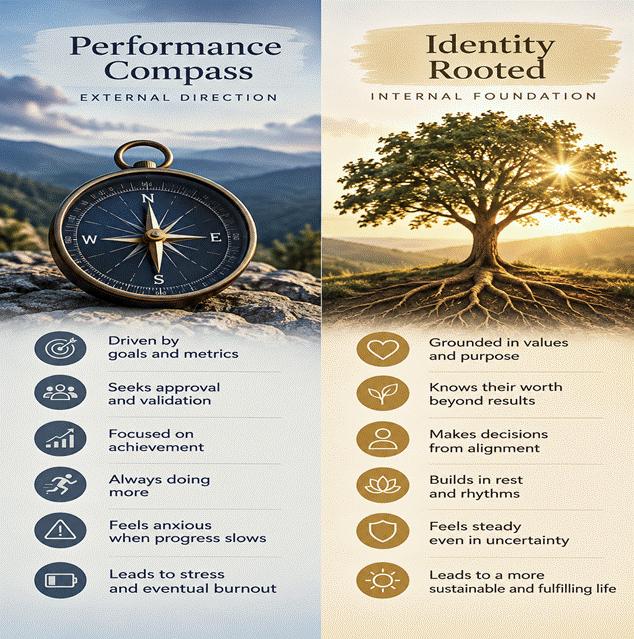
Here is the thread that runs through everything I do. When your worth is tied to your performance, every leadership skill you learn gets quietly recruited to protect that worth. You communicate to be liked. You decide to avoid blame. You work late to prove you belong.
But when your identity is settled, when you know whose you are and the gifts you carry, those same skills are finally free to do what they were meant to do: serve people and build something that lasts. That is why I do not see transformational coaching and executive coaching as competitors. One builds the foundation. The other builds on it.
Not Sure Which One You Need? Start Here.
You do not have to figure this out alone, and you do not have to choose perfectly before you reach out. That is exactly what a Discovery Call is for. We will talk through what is really going on, and I will tell you honestly which path fits, even if the answer is that you need a different kind of support than I offer. I believe consistent small steps, grounded in faith, integrity, and perseverance, lead to profound transformation, and this conversation can be your first one.
You can explore current packages and pricing here, learn more about my story and background, grab the free guide, or visit the Shaping Pathways homepage to see everything in one place. When you are ready, schedule a Discovery Call, and together we will begin shaping a pathway that honors your gifts, your calling, and the leader you were created to be.
Frequently Asked Questions
What is the difference between transformational coaching and executive coaching?
Executive coaching focuses on your performance and leadership within a professional role, such as decision making, communication, and strategy. Transformational coaching focuses on the identity, beliefs, and fears underneath that performance. One sharpens how you lead. The other strengthens the foundation you lead from.
Which is better, transformational coaching or executive coaching?
Neither is better. They address different layers. Executive coaching fits a specific professional goal or transition. Transformational coaching fits a deeper, repeating pattern, like burnout or feeling empty despite your success. Many leaders benefit most from combining both.
Can I do transformational and executive coaching at the same time?
Yes. In my practice, they are designed to work together. We typically begin with the identity level work so your leadership skills rest on a steadier foundation, then layer in executive strategy, communication, and decision making.
Who is executive coaching for?
Executive coaching is typically for managers, directors, and senior leaders who want to grow their leadership impact, prepare for a bigger role, navigate a transition, or work through a specific challenge in how they lead.
Who is transformational coaching for?
It tends to fit professionals who are successful but feel hollow, who keep running into the same emotional pattern in different situations, or who want a growth process that includes faith and identity, not just performance.
Is a transformation life coach the same as an executive coach?
Not exactly. A transformation life coach works with the whole person, including identity, purpose, and relationships, while an executive coach focuses on professional leadership performance. Some coaches, including me, offer both so the work never gets split into disconnected pieces.
How do I know if I need transformational coaching instead of executive coaching?
If your challenge is a specific skill or situation at work, executive coaching is usually the right place to start. If you are succeeding on paper but feel exhausted, empty, or stuck in a repeating pattern, transformational coaching is often the better entry point. A Discovery Call can help you sort that out with clarity.
Is transformational coaching the same as therapy?
No. Therapy often focuses on diagnosing and treating mental health conditions and processing the past with a licensed clinician. Transformational coaching is forward focused and works with generally healthy individuals. If you are walking through trauma or a mental health condition, a licensed therapist is the right first step, sometimes alongside coaching.
Can I work with you remotely?
Yes. I coach clients nationwide and internationally by phone or video, so you do not need to live near Jacksonville for us to work together.
Related reading: What Is Transformational Life Coaching? · How Life Transformation Coaching Works · Over Performing at Work · The Lie of the Empty Tank: A Leader’s Burnout Check · The Midyear Burnout Check
Explore coaching services: Homepage · Executive Coaching · Leadership Coaching · Career Development Coaching · Personal Development Coaching · FAQs · Free Guide