

There’s a particular kind of weight that shows up when you’re standing at the edge of a necessary change.
Not a “maybe one day” change.
A God, I know this can’t stay the same change.
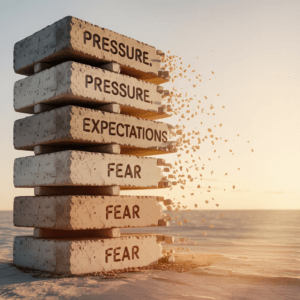
And yet even when your spirit knows the direction, your body can feel like it’s carrying bricks.
If that’s where you are tired, prayerful, high-achieving, and quietly afraid—you are not weak. You are not behind. You are not “too emotional.”
You are human. And you’re a woman of color in leadership, which means you’ve likely been strong in rooms that never made it easy to be soft.
So let’s talk about why change can feel heavy… even when it’s necessary.
Why Necessary Change Still Feels So Heavy
Sometimes we think, If this is the right move, shouldn’t I feel peace right away?
But peace doesn’t always show up as a feeling first.
Sometimes peace shows up as a decision you make before the emotions catch up.
The truth is: heaviness is often a sign you’ve been holding more than your share
When you’re the one who “keeps it all together,” change doesn’t just mean a new role or a new season.
It can mean:
And for women of color in leadership, that weight is not imagined.
Research from McKinsey and LeanIn shows that women, especially women who are “Onlys” in the room often carry added scrutiny and experience more microaggressions, which erodes belonging and increases pressure. In their Women in the Workplace research, 1 in 5 women say they’re often the only woman in the room, and 2 in 5 are often the only one for their race.
That’s not a personality problem. That’s an environment problem.
When your identity has been tied to performance, change feels like a threat
If you’ve spent years proving yourself, your nervous system can interpret change as danger, even when your spirit knows it’s growth.
This is what career transition stress can feel like:
That internal pressure is real. And it’s exhausting.
Leadership Burnout and the Emotional Cost of Carrying It Alone
Let me say this gently: you can be called and still be tired.
Leadership burnout doesn’t always look like falling apart.
Sometimes it looks like:
And the data is catching up to what you’ve been living.
LeanIn’s Women in the Workplace 2025 findings reported that six in ten senior-level women say they frequently feel burned out, compared with about half of senior-level men, and about four in ten employees overall.
That’s not “you being dramatic.” That’s a pattern. Microaggressions don’t just sting, they drain. McKinsey and LeanIn also found that microaggressions have what they call a “macro impact.”
Women who experience multiple microaggressions are:
If you’ve been telling yourself, I should be able to handle this, I want you to hear me:
What you’ve been handling was never meant to be carried alone.
Imposter feelings don’t mean you’re an imposter when you reveal it, it is just fear.
And let’s talk about the quiet confidence thief: imposter syndrome which is just fear.
A KPMG study of executive women found that as many as 75% reported experiencing imposter syndrome, which is the worldly term for fear, at certain points in their careers.
So if you’ve been thinking, Maybe I’m the only one who feels this way, you’re not.
But here’s the deeper truth:
Imposter feelings often show up when you’re:
A Faith Perspective: God Does Not Waste Necessary Change
One of the most tender things I’ve learned in my own leadership journey is this:
God is not only interested in your promotion. He is invested in your formation.
Sometimes He allows a change not because you failed… but because you’re ready to become.
God often does His deepest work in “in-between” seasons
Scripture is full of leaders who had an in-between:
The wilderness wasn’t punishment.
It was preparation.
And if your season feels like pruning, where things are being cut back, shifted, or shaken, I want you to remember John 15’s principle: pruning is connected to fruitfulness.
Not because God is harsh. Because He’s intentional.
Faith during career change isn’t pretending you aren’t scared, it’s bringing the fear to God
Faith sounds like:
Sometimes the most spiritual thing you can do is tell the truth in prayer.
Practical Emotional and Spiritual Support Steps When Change Feels Heavy
Let’s get practical because I don’t want you just inspired. I want you supported.
These are steps I often walk through with women navigating career transition stress, leadership burnout, and identity beyond work.
1) Name what you’re actually grieving
Not every heavy season is about the job itself.
Sometimes you’re grieving:
Try journaling this one sentence:
“What I’m grieving is…”
Then pause. Let it be honest.
God can handle your honesty.
2) Separate your calling from your current role
Your role is what you do. Your calling is who you are becoming with God.
A title can change. Your purpose doesn’t disappear.
If you need a grounding reminder, speak this over yourself:
“I am not my position. I am God’s daughter with assignment.”
3) Build a boundary that protects your peace, not your image
If you’re emotionally exhausted, your next faithful step might be a small boundary not a giant leap.
One simple boundary could be:
Boundaries aren’t rebellion. They’re stewardship.
4) Create a “fear of losing your job” plan; without living in fear
Fear gets louder when you feel unprepared. So we respond with wisdom, not panic.
A calm plan can include:
This is not faithlessness. This is Proverbs-level wisdom: preparing while trusting God.
5) Strengthen your support system
Even strong leaders need safe spaces.
Ask yourself:
If your answer is “I don’t really have that,” please don’t shame yourself.
Just let that be information and an invitation to build what you deserve.
6) Pray a simple, honest prayer when you don’t have fancy words
Here’s one you can borrow:
“Lord, I’m tired. I’m scared. And I’m willing.
Show me what to release, what to keep, and what to do next.
Give me peace that holds; peace that leads. Amen.”
Quick Answers for Real-Life Moments
Why does change feel heavy even when it’s necessary?
Because necessary change often includes grief, uncertainty, and identity shifts. For women of color in leadership, it can also stir up old survival patterns from being over-scrutinized or unsupported at work.
How do I handle career transition stress with faith?
Bring the fear to God honestly, take one practical step at a time, and ask for wisdom not just relief. Faith is not denial; it’s dependence.
What helps with leadership burnout when you feel emotionally exhausted?
Support, boundaries, and recovery time plus naming what’s draining you (including microaggressions and chronic pressure). Burnout is often a signal that something needs to change, not a sign you’re failing.
Is imposter syndrome normal for high-achieving women?
It’s common especially for women leaders. One study of executive women reported that up to 75% experienced imposter syndrome at points in their careers. Imposter syndrome is the worldly definition of – FEAR. Identify what is the real fear underneath the surface and start to unearth it. This is where the real work begins.
An Identity Reminder for the Woman Who Feels Like She’s Disappearing
Hear me: you are not losing yourself.
You’re being reintroduced to who you were before the striving.
Before the perfectionism. Before the pressure to be “twice as good.”
Your value is not hanging on your next performance review. Your worth is not waiting on someone else’s approval. And your peace is not something you earn.
It is something you receive and protect. Also, I want to name something tender and for many of us, faith isn’t just a belief system. It’s a lifeline. And research continues to explore how spiritual practices and religious involvement relate to well-being over time, including mental health indicators like life satisfaction and depressive symptoms.
That doesn’t replace therapy. It doesn’t erase injustice.
But it does remind us: God built you for connection to Him and he will reveal to you who your truly are and what you’re really meant to do.
A Gentle Invitation to Support
If this feels like the season you’re in, you don’t have to walk it alone.
At Shaping Pathways Inc., I work with women navigating change that’s both professional and deeply personal career shifts, leadership burnout, fear of losing your job, and the tender work of rebuilding identity beyond work.
Through my PATHs™ coaching framework, we create space to:
If you’re longing for peace, clarity, and alignment with God especially in a season that feels heavy, I’d love to support you through a Discovery Call.
Not to push you.




WhatsApp us